Downstream Rate Limiting 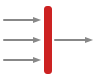
TLDR
Used to rate limit outbound requests to a downstream service. Use this to limit the rate of requests, such as to a third-party API, or payment processor, or other external system, that concurrent Workflows would otherwise exceed.
Overview
The Downstream Rate Limiting pattern, also known as Task Queue rate limiting, caps how many Activities execute per second against a downstream service. You place throttled Activities on a dedicated Task Queue backed by Workers configured with MaxTaskQueueActivitiesPerSecond. The Temporal matching service enforces this limit before dispatching tasks, so the downstream service receives a controlled request rate regardless of how many Worker instances or Workflow executions are running concurrently.
Problem
Many downstream systems — LLM providers, payment processors, third-party REST APIs — enforce requests-per-second limits. Some systems cannot handle more than a defined level of requests per second. When many Temporal Workflows schedule Activities concurrently, the resulting burst can saturate those limits, causing request failures, cascading retries, and increased latency for all callers.
Without centralized throttling, each Activity implementation must manage backpressure independently, which scatters policy across the codebase and provides no enforcement at the Temporal scheduling layer.
Solution
You assign rate-limited Activities to a dedicated Task Queue and Worker set and configure the Workers on that queue with a throughput cap. Because the limit applies to the Task Queue, it is enforced before any Worker executes an Activity, and it holds across all Worker replicas without coordination.
The Workflow routes the throttled Activity to the dedicated queue by specifying an explicit task_queue override in the Activity options.
The following describes each step in the diagram:
- Any number of Workflows schedule
callApiActivities to the dedicatedrate-limited-tqTask Queue via an explicittask_queueoverride in their Activity options. - The Temporal server holds tasks in
rate-limited-tq. The queue depth grows if submission rate exceeds dispatch capacity. - Two Workers poll the queue. Each is configured with
MaxTaskQueueActivitiesPerSecond = 5, so together they dispatch at most 5 Activity tasks per second — matching the downstream API's rate limit. - The downstream API receives a steady, controlled request rate regardless of how many Workflows are running concurrently.
Implementation
Worker configured with a throughput cap
# worker.py
# This is a dedicated worker for rate-limited activities.
# You will also need a separate worker registered on your workflow task queue.
from temporalio.worker import Worker
from activities import call_api

async def run_worker(client):
    worker = Worker(
        client,
        task_queue="rate-limited-tq",
        activities=[call_api],
        max_task_queue_activities_per_second=5.0,
    )
await worker.run()// main.go
// This is a dedicated worker for rate-limited activities.
// You will also need a separate worker registered on your workflow task queue.
w := worker.New(c, "rate-limited-tq", worker.Options{
TaskQueueActivitiesPerSecond: 5.0,
})
w.RegisterActivity(CallApi)
if err := w.Run(worker.InterruptCh()); err != nil {
log.Fatalf("worker error: %v", err)
}// WorkerSetup.java
// This is a dedicated worker for rate-limited activities.
// You will also need a separate worker registered on your workflow task queue.
WorkerOptions rateLimitedOptions = WorkerOptions.newBuilder()
.setMaxTaskQueueActivitiesPerSecond(5.0)
.build();
Worker rateLimitedWorker = factory.newWorker("rate-limited-tq", rateLimitedOptions);
rateLimitedWorker.registerActivitiesImplementations(new RateLimitedActivitiesImpl());
factory.start();Activity definition
# activities.py
from temporalio import activity

@activity.defn
async def call_api(input: str) -> str:
return await downstream_api.call(input)// activities.go
func CallApi(ctx context.Context, input string) (string, error) {
return downstreamApi.Call(input)
}// RateLimitedActivities.java
@ActivityInterface
public interface RateLimitedActivities {
@ActivityMethod
String callApi(String input);
}
public class RateLimitedActivitiesImpl implements RateLimitedActivities {
@Override
public String callApi(String input) {
return downstreamApi.call(input);
}
}Workflow routing to the rate-limited queue
# workflows.py
from datetime import timedelta
from temporalio import workflow
from activities import call_api

@workflow.defn
class MyWorkflow:
    @workflow.run
    async def run(self, input: str) -> str:
        return await workflow.execute_activity(
            call_api,
            input,
            task_queue="rate-limited-tq",
            start_to_close_timeout=timedelta(seconds=30),
)// workflow.go
func MyWorkflow(ctx workflow.Context, input string) (string, error) {
ao := workflow.ActivityOptions{
TaskQueue: "rate-limited-tq",
StartToCloseTimeout: 30 * time.Second,
}
ctx = workflow.WithActivityOptions(ctx, ao)
var result string
err := workflow.ExecuteActivity(ctx, CallApi, input).Get(ctx, &result)
return result, err
}// MyWorkflowImpl.java
public class MyWorkflowImpl implements MyWorkflow {
private final RateLimitedActivities rateLimitedActivities =
Workflow.newActivityStub(RateLimitedActivities.class,
ActivityOptions.newBuilder()
.setTaskQueue("rate-limited-tq")
.setStartToCloseTimeout(Duration.ofSeconds(30))
.build()
);
@Override
public String run(String input) {
return rateLimitedActivities.callApi(input);
}
}When to use
This pattern is a good fit when your Workflow calls a downstream service with explicit requests-per-second limits, when you need throughput enforcement that holds across many concurrent Workflow instances without per-Activity logic, and when only a subset of Activity types require throttling and others should run without restriction.
It is not a good fit when you need concurrency limits rather than throughput limits (see Priority Task Queues), when the downstream system has no rate limit and throughput is bounded only by Workflow logic, or when all Activities require the same limit and a single shared queue suffices.
Benefits and trade-offs
Centralizing rate limiting at the Task Queue ensures enforcement even when any number of Workflow instances run in parallel. Because the Temporal server controls dispatch, the limit holds regardless of how many Worker replicas are running — provided you account for Worker count when setting the per-worker cap.
Dedicated Task Queues require operating additional Workers. If the throughput cap is set too low relative to demand, the queue depth grows and scheduling latency increases. You must size the Worker pool so that slot availability does not become the bottleneck before the rate limit is reached.
Comparison with alternatives
| Approach | Enforcement point | Works across Workers | Runtime adjustable | Complexity |
|---|---|---|---|---|
MaxTaskQueueActivitiesPerSecond | Temporal matching service (server-side) | Yes | No (requires redeploy) | Low |
MaxWorkerActivitiesPerSecond | Worker SDK poller (worker-side) | No — per-worker only | No (requires redeploy) | Low |
Concurrency slots (MaxConcurrentActivityExecutionSize, MaxConcurrentWorkflowTaskExecutionSize, MaxConcurrentLocalActivityExecutionSize) | Worker executor | No — per-worker only | No (requires redeploy) | Low |
| Sleep-based throttle in Workflow | Workflow scheduler | No | Via signal | Low |
| Client-side token bucket in Activity | Activity execution | Per-worker only | No | Medium |
| API gateway rate limiting | Network layer | Yes | Yes | High |
Three distinct layers of worker-side control exist alongside the server-side queue limit. MaxWorkerActivitiesPerSecond instructs the SDK to self-throttle its polling — the Worker will not request a new Activity task if doing so would push it over this rate. Because the limit is per-process, multiple Workers on the same queue each apply it independently, so the effective queue throughput is the per-worker cap multiplied by Worker count. By contrast, MaxTaskQueueActivitiesPerSecond is a server-side instruction: the Temporal matching service slows dispatch for the entire queue regardless of how many Workers are polling, making it the correct tool for protecting a shared downstream service.
The concurrency slots (MaxConcurrentActivityExecutionSize, MaxConcurrentWorkflowTaskExecutionSize, MaxConcurrentLocalActivityExecutionSize) are not throughput limits but define the number of execution slots available on a Worker. A Worker will not accept more tasks than it has open slots, so a low slot count acts as an indirect throughput ceiling.
Best practices
- Use a separate Task Queue for each rate limit.
MaxTaskQueueActivitiesPerSecondapplies to every Activity on the queue. Mixing rate-limited and unrestricted Activities on the same queue will throttle the unrestricted ones too. - Run at least two Worker processes per queue for availability. A single Worker process is a single point of failure. With two Workers, keep the per-worker cap at half the target RPS so the combined rate stays at the intended limit.
- Monitor queue depth and schedule latency. Track the
temporal_activity_schedule_to_start_latencymetric on the rate-limited queue; sustained growth signals that demand consistently exceeds the configured cap. You can also query the Task Queue'sApproximateBacklogCountvia theDescribeTaskQueueAPI — a steadily growing backlog count is a direct indicator that the configured RPS cap is too low for the current submission rate.
Common pitfalls
- Forgetting to override the task queue in Activity options. If the Workflow does not explicitly specify
task_queuein the Activity options, the Activity runs on the Workflow's default queue and bypasses the rate-limited Worker entirely. - Setting conflicting MaxTaskQueueActivitiesPerSecond limits in workers. This setting is set in Workers and sent to the Task Queue when a Worker polls. If you have multiple Workers with conflicting settings, the Workers will overwrite each other as they poll.
- Confusing throughput limits with concurrency limits.
MaxTaskQueueActivitiesPerSecondcontrols starts per second;MaxConcurrentActivityExecutionSizecontrols simultaneous executions. Long-running Activities that hold slots for minutes may exhaust concurrency before the RPS cap applies. - Setting the cap far below actual demand. A cap much lower than actual submission rate causes the queue to grow unboundedly. Monitor queue depth and raise the cap or add more Workers when throughput requirements grow.
Related patterns
- Priority Task Queues: Route work to separate queues by urgency, with different concurrency budgets per tier.
- Fairness: Give each tenant an equal throughput share when multiple tenants share capacity.
- Worker-Specific Task Queues: Route Activities to a specific Worker host for resource or data affinity.
References
- Python —
max_task_queue_activities_per_secondonWorker - Go —
TaskQueueActivitiesPerSecondinworker.Options - Java —
setMaxTaskQueueActivitiesPerSecondonWorkerOptions.Builder - Temporal Community — Rate limit configuration and best practices